Assessment Drives Instruction in Component 4: The Part Most Candidates Underestimate
Aug 09, 2026Here's the thing about Component 4: most candidates walk in thinking the assessment section is where they prove their students learned something. Show the test. Report the scores. Move on.
But that's not the story the Generation and Use of Assessment Data section of Component 4 is asking you to tell.
Let's dig in.
It still starts with needs
I say this in every component—and it's especially true in Component 4: lead with needs.
Before you generate a single assessment, you've already done the hard, beautiful work of getting to know this group and identifying their student needs. You pulled data on their strengths and their gaps. You talked to colleagues who see them in other settings. You looped in specialists, families, and sometimes the wider community. You didn't guess who these kids are — you excavated it.
That clear picture of the group's needs is the foundation the entire unit sits on. Every assessment you choose from here forward should point back to it. If an assessment doesn't connect to a need you identified, ask yourself why it's in the unit at all.
So when you sit down to design your unit and its assessments, you're not asking "What should I test?" You're asking: "What do these particular students need to move toward, and how will I know they're getting there?"
That reframe changes everything. If you're still trying to understand how all of the pieces of Component 4 fit together, assessment becomes much easier when every decision begins with a documented student need.
The three assessments, and the job each one does
Here's where candidates go off course — not because they didn't assess, but because they treated formative, self, and summative assessment like three boxes to check instead of three tools doing three different jobs.
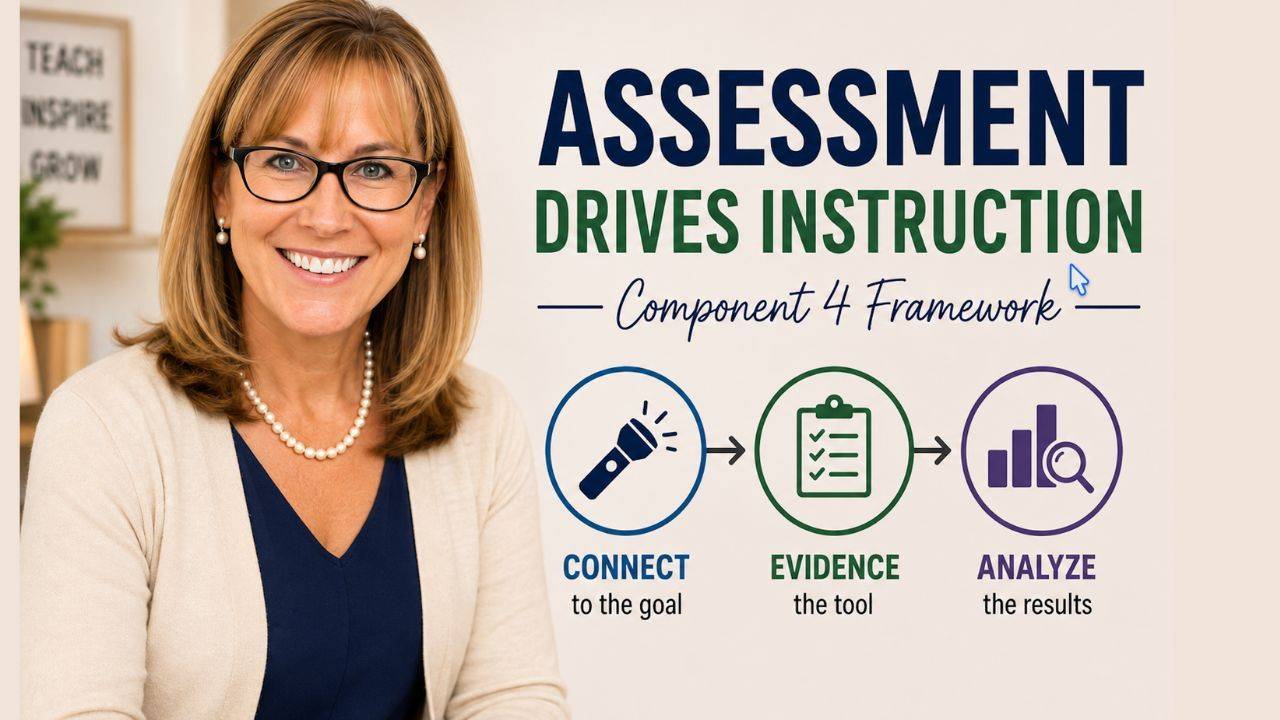
Formative assessment is your flashlight. It's the quick, in-the-moment check that tells you where kids are while there's still time to do something about it. Exit tickets, a quick sort, thumbs-up-thumbs-sideways, a two-minute conference. The point is how does the formative data inform a pivot in your instruction. Formative assessment exists so you can change course mid-unit: reteach, regroup, speed up, slow down. When you show a scorer your formative evidence, what they really want to see is the moment you looked at it and adjusted.
Self-assessment hands the learning back to the student. When students assess their own progress against the goal — a rubric they can actually read, a checklist, a reflection, a "where am I / where am I headed" — you're building the thing every teacher wants: ownership. Kids who can name where they are can steer toward mastery. And for your portfolio, self-assessment is gold, because it shows learning happening inside the student, not just being measured from the outside.
Summative assessment answers the question the whole unit asked. Did we get there? Did this group move toward the needs we named at the beginning? But here's the part people miss: summative isn't the end of the story. What you learn from it becomes your next data pull — the pivot after the unit. Where are they still short? What does that tell you about your next unit, your next grouping, your next move?
The through-line: connect, evidence, analyze
If you remember nothing else, remember these three:
Connect it to the goal. Every assessment should trace back to a need you identified and a goal you set. When you can say "I chose this because these students needed that," you're demonstrating exactly the intentionality Component 4 rewards.
Evidence the tool. Don't just describe what you assessed — show it. The exit ticket, the rubric, the self-reflection form, the summative task. The tool is the artifact that proves the practice was real.
Analyze the results. This is the one that separates a passing entry from a strong one. It's not enough to say what students scored. You have to say what the results told you — and what you did because of it. "This assessment showed me X, so I did Y." That sentence, over and over, is the sound of a teacher using assessment to drive instruction.
Why this matters more than the scores
When you use a variety of assessments on purpose — flashlight, ownership, and mastery-check all working together — you stop guessing and start seeing. You catch kids before they fall behind. You hand them the wheel. And you close the unit knowing exactly what these students need next.
That's not a testing section. That's teaching. And it's the exact story Component 4 is asking you to tell.
You already do this work in your classroom every single day. Component 4 just asks you to make it visible — and once you see how the pieces fit, you'll wonder why anyone made it feel so complicated.
You've got this! And if you're ready to organize your evidence, assessments, and commentary with confidence, explore my Component 4 coaching and resources.
