You have already answered all four of them. Probably this week
Jul 20, 2026Most teachers open the National Board materials for the first time and come away with the same impression: this is going to ask me to teach differently.
It isn't. That is the thing that takes the longest to believe, and it is the thing that changes how the whole process feels once you do.
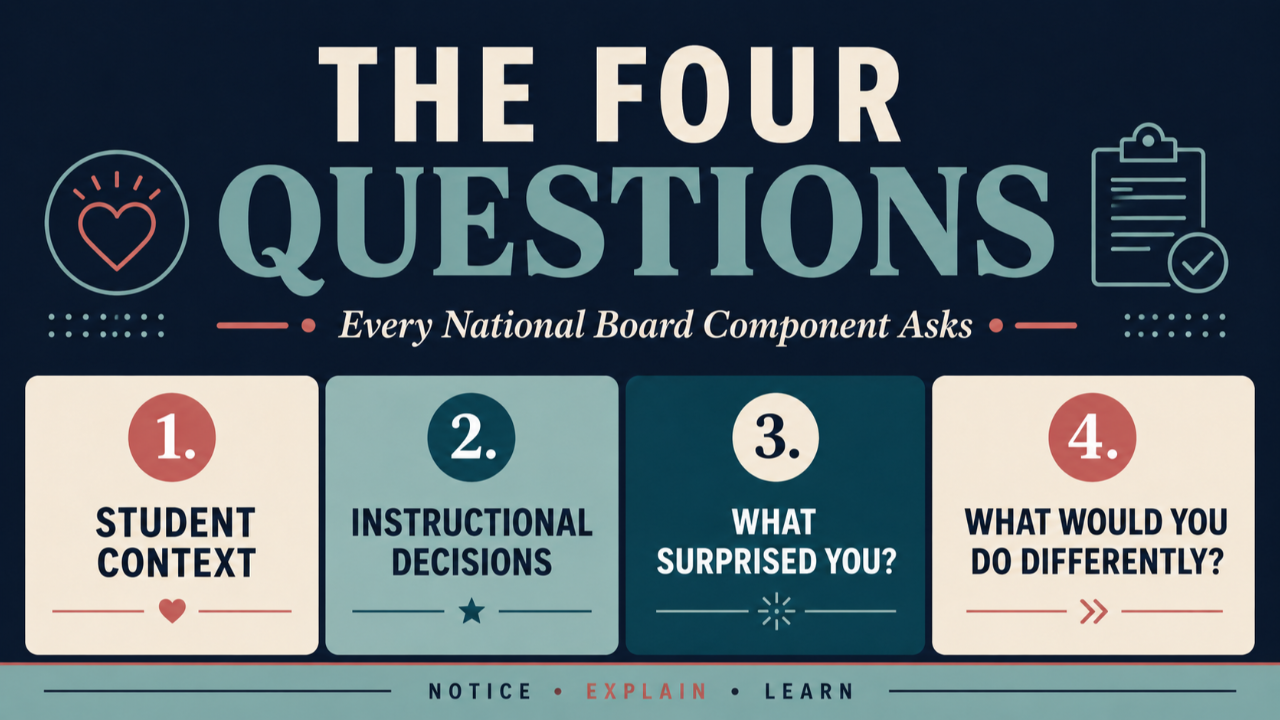
Underneath the component names, the rubrics, the page limits, and the video requirements, National Board is asking you four questions. The same four, in different forms, across all four components. And you answer them constantly — in the hallway, in the ten seconds before you change direction mid-lesson, in the car on the way home. What certification asks is that you say those answers out loud, on paper, with evidence attached.
Here they are.
1. Who are your students, and what did you change because of what you know about them?
This is the student context question. It shows up in every component, and it is the one teachers underestimate most, because knowing your students feels like the baseline, not the achievement.
But think about this week. There is a student you moved to a different seat, and it wasn't about behavior. There is a student you stopped calling on cold, because you learned that public wrong answers shut him down for the rest of the period, so now you check in with him quietly first and then call on him when you already know he has it. There is a student whose reading level says one thing and whose questions in discussion say something completely different, and you have been adjusting to the second one.
None of that was in your plan. All of it is student context, and all of it is evidence.
Name three students you already changed something for this week. That's the question.
2. What did you do — and why did you choose that approach?
This is the instructional decision question, and it is where teachers most often write themselves short.
The instinct is to describe the lesson: we read the passage, then discussed it in pairs, then wrote a response. That describes what happened in the room. It does not answer the question.
The question is why pairs and not groups of four. Why that passage and not the one in the anthology. Why did you give them the writing prompt before the discussion instead of after. You had a reason for each of those. You may never have said it out loud, because the reason lives in your hands rather than your notes, but it exists — and pulling it into words is most of the work.
What did you do in the first ten minutes today that wasn't in your plan? Whatever it was, you decided it in real time, based on something you noticed. That decision and that noticing are what the component is asking for.
3. What surprised you — and what happened as a result?
This is the question that separates a strong entry from a flat one, and it is the one teachers are most tempted to leave out, because surprise can feel like something went wrong.
It didn't. Surprise means you were watching closely enough to notice the gap between what you expected and what actually happened. That is not a failure of planning. It is the evidence of an accomplished teacher paying attention.
A student gives you an answer that is wrong in an interesting way, and the misconception underneath it turns out to be shared by half the class. A group gets to the right result by a route you had not considered. A lesson you were sure would land goes flat by minute six, and you can see it in their faces before anyone says a word.
What matters to the assessor is the second half of the question: what happened as a result. What did you do with the surprise? That's the answer that shows you are teaching students, not delivering a plan.
4. What would you keep, change, or try next?
This is the reflection question, and here is what to know about it: reflection in National Board terms is not the same as reflection in most professional development. It is not about how you felt. It is about what you would do differently and why that change follows from the evidence you just described.
You already do this. It happens on the drive home, and it happens in the file where next year's version of the unit lives, and it happens when you rewrite a set of directions in October because you remember what confused them last October.
The component asks you to make that visible: if you taught this lesson again, what would you keep, what would you change, and what does your student evidence say about why?
Why this changes what the process actually asks of you
If the National Board were asking you to become a different teacher, the work would be enormous, and you would be starting from zero.
It isn't. It is asking you to notice, explain, and learn from the decisions you already make. That's a different kind of work — it’s a transformation through translation. The teaching is already there. What the components require is that you make it visible to someone who has never been in your room.
That is harder than it sounds, and it is the part most candidates underestimate. Not because the thinking is missing, but because it has been automatic for so many years that pulling it back into language takes deliberate effort. This is also why the candidates who struggle are rarely the ones who aren't good enough. They are the ones writing what happened instead of why they chose it, and nobody has read it back to them and pointed at the gap.
The part that depends on timing
Here is the practical consequence of all four questions: they are all answered with evidence, and evidence has to exist before you can write about it.
Which means the strongest entries are built from things you noticed in September, not things you reconstructed in March.
Component 4 in particular runs on evidence covered over a few months, which is why it starts in August rather than February. But all four components run on the same fuel. If you are considering certification this cycle, the useful thing to do in the first weeks back is not to read the standards cover to cover. It is to start writing down what you notice.
Where to start
I put together a short guide for the first thirty days back — what to collect, what to skip, and how to record a decision in about ninety seconds so it is still usable in the spring. It is built around these same four questions.
Get here: First 30 days Checklist for Analysis & Reflection
You are already doing the teaching. This is about making sure you can prove it.
